GSI 18
Screening Audiometer
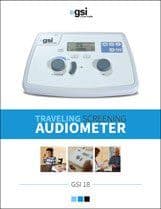
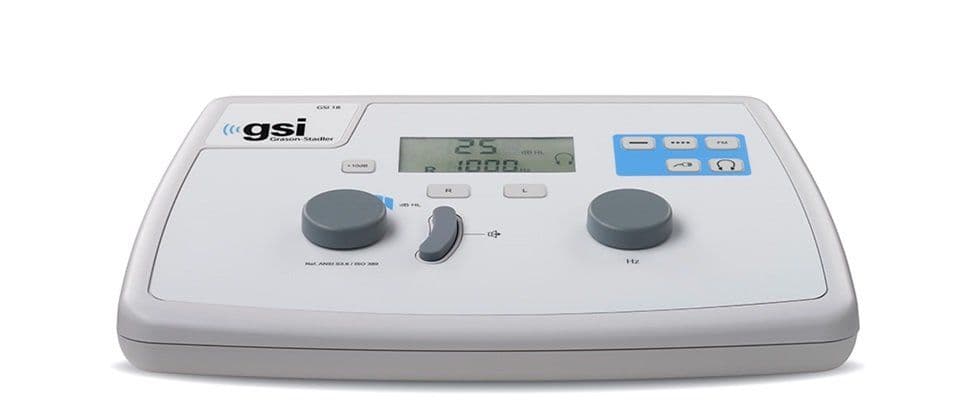
Flexible and efficient, the GSI 18™ is a portable audiometer that travels with you. The GSI 18 is a great choice for clinicians who conduct audiometric testing in multiple environments. The audiometer provides three stimulus options and a choice between two transducers to accommodate all screening environments. In a school screening environment, it’s easier for the operator to test hearing on a distracted child with a more interesting signal. In an industrial screening environment, the operator can present a signal that allows the patient to distinguish the signal from “ringing” in the ear.
Request Quote
Frequently Asked Questions
Can the GSI 18 be operated with batteries?
Conducting a hearing test does not depend on a power source. While the device can operate on AC power, you can get up to 10 full hours of testing using five AA batteries. This is ideal when out in the field, conducting testing at health fairs, and during home visits.
When is it best to use the patient response button?
This is a great way to conduct screening audiometry with all patient types. A patient response button helps testers concentrate on results, instead of visual cues from the patient.
Do all the accessories and device fit in a compact case?
Yes, the GSI 18 is easy to take from site to site when conducting screening visits. This portable audiometer has everything needed for testing and users can easily carry it in a convenient case.
What options do you have for a noisier environment?
Users can switch between using headphones and insert phones with the GSI 18 depending on the environment. Using insert phones in noisy school and industrial screening environments can help control noise and achieve more accurate results.
What frequency and intensity range is available for air conduction testing?
The GSI 18 allows the operator to test frequencies from 125 to 8000 Hz at intensities from 0 to 100 dB, unlike other screeners. This allows the operator to conduct hearing screenings on all levels of hearing loss.

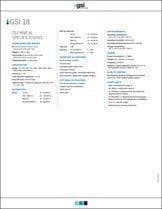
Product Specifications
• W x D x H: 12.6 in x 8.8 in x 3.2 in (32 cm x 22.4 cm x 8.1 cm)
• Weight: 2.5 lb (1.1 kg)
• Shipping W x D x H: 16 in x 16 in x 8 in (40.6 cm x 40.6 cm x 20.3 cm)
• Shipping Weight: 7.5 lb (3.4 kg)
FREQUENCY RANGE
• Range: 125, 250, 500, 750, 1000, 1500, 2000, 3000, 4000, 6000, and 8000 Hz
• Accuracy: +/- 2%
• Total Harmonic Distortion: < 2.5%
• Rise/Fall Time: 20 to 50 msec
• Signal Format: Continuous, pulsed (2.5 per sec), FM (+/- 5%, 5 Hz)
DD 45
• 125 Hz: -10 dB HL - 60 dB HL
• 500 - 4000 Hz: -10 dB HL - 100 dB HL
• 6000 Hz: -10 dB HL - 95 dB HL
• 250 and 8000 Hz: -10 dB HL - 80 dB HL
EAR 3A (Optional)
• 125 Hz: -10 dB HL - 50 dB HL
• 500 - 4000 Hz: -10 dB HL - 90 dB HL
• 6000 Hz: -10 dB HL - 80 dB HL
• 250 and 8000 Hz: -10 dB HL - 70 dB HL
STEP SIZE
• 5 dB
ACCURACY
• 125 - 4000 Hz: +/- 3 dB
• 6000 and 8000 Hz: +/- 5 dB
• DD 45 headset (10 ohm)
• Carrying case
• Audiogram pad (1 pad of 50)
• Instruction manual
• Quick reference guide - threshold audiometry
• External power supply with multiple adaptors
OPTIONAL
• EAR 3A insert phones (10 ohms)
• Subject response handswitch
• Patch cord (1)
• Audio cups
• Temperature: 59° F (15° C) to 104° F (40° C)
• Operating Humidity: 15% to 95% (non-condensing)
• Operating Ambient Pressure: 98 kPa to 104 kPa
• Storage Temperature: -93° F (-69° C) to 149° F (65° C)
• Power Consumption: 1.5 Watts
• Voltage: 100-240 VAC, 1.0 A max
• Frequency: 50/60 Hz}
• Batteries, 5 Each (Optional): Alkaline AA 1.5V or Rechargeable NiCad or NiMH AA 1.2V
Manufactured, designed, developed, and marketed under ISO 13485 certified quality systems.
• ANSI S3.6 Audiometer (type 4)
• IEC 60645-1 Audiometer (type 4)
• IEC/EN 60601-1 Medical Electrical Equipment Requirements for Safety
• IEC/EN/60601-1-2 Medical Electrical Equipment Requirements for Electromagnetic compatibility
• CSA C22.2 No.601-1-M90
• Medical Device Directive 93/42/EEC

Multiple Routes to Results
The GSI 18 is a logical choice for every screening environment. Full frequency and intensity range allows for simple screening or more advanced air conduction threshold evaluations. The patient response button, stimulus options, and choice of two transducers make it ideal for screening varied patient populations.

Portability Provides Options
Take advantage of the features on the GSI 18 while testing remotely. Weighing in at 2.5 pounds, this audiometer is perfect for traveling from site to site.
Do not limit your testing by having access to a power source. Choose from AC or battery operation. By installing five AA batteries, you can conduct 10 hours of testing.

Switch Freely
Easily switch between supra-aural and insert headphones as the environment dictates. The GSI 18 audiometer holds calibration for two air conduction transducers. Comply with infection control policies with disposable insert eartips.
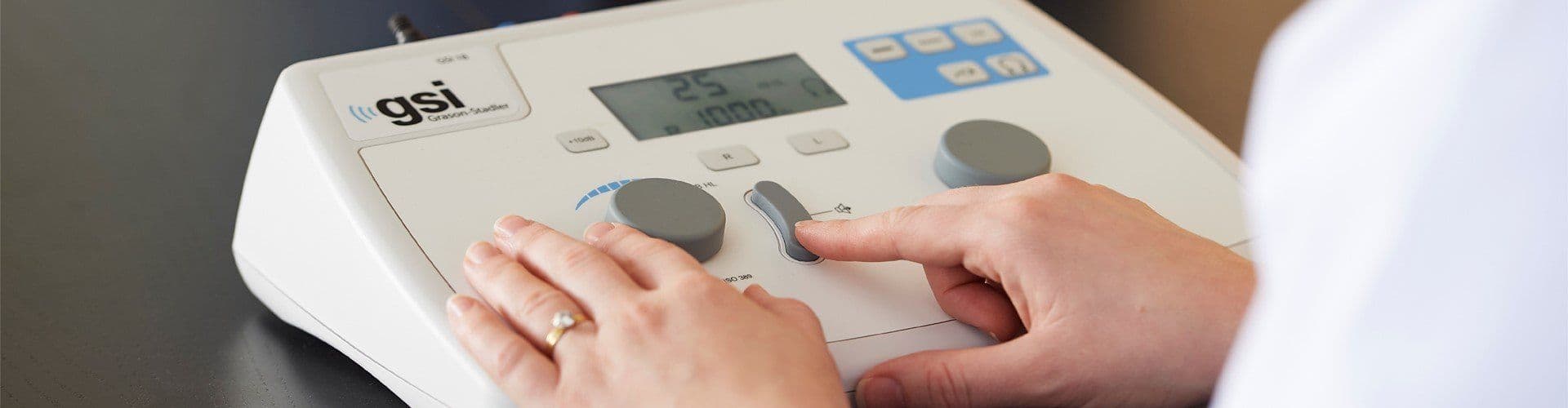
Full Frequency and Decibel Range
Users can easily get full air conduction results. This covers a frequency range of 125 to 8000 Hz and a decibel range of 0 to 100 dB.
Key Audiometer Features
1. Familiar Interface
Performing screening audiometry requires minimal training because of the recognizable layout and GSI’s legacy of simple operation.
4. Flexible Operation
The GSI 18 holds calibration for two transducers: the DD45 supra-aural headphones and the EAR 3A insert phones. Easily switch transducers with a single button press to accommodate screening needs.
2. Stimulus Options
Steady, pulsed, and FM pure tone options accommodate all screening environments.
5. Frequency and Decibel Range
Provides the ability to conduct complete pure tone audiometry evaluations for all levels of hearing loss. Achieve thresholds from 125 Hz to 8000 Hz and 0 to 100 dB HL.
3. Patient Comfort
The GSI 18 audiometer offers an optional patient response button for threshold testing.
6. Lightweight and Portable
Everything the user needs for portable testing is included. The GSI 18 includes a convenient carrying case for easy transport between testing sites.
Visit the Audiometers Page for a full list of available GSI audiometers.
Featured Videos
PRODUCT TUTORIAL
Getting Started with Testing
PRODUCT TUTORIAL
Basic Device Operation
PRODUCT TUTORIAL
What Happens During Testing
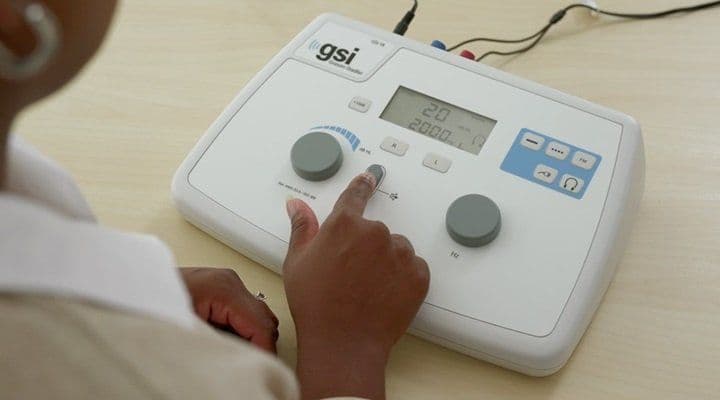
New Tutorial Video
Follow the link to access the new GSI 18 tutorial, along with other training materials. Topics covered include:
- Basic Device Operation
- Getting Started with Testing
- Preparing the Patient
- What Happens During Testing
Next Steps
Learn more by checking out our materials below or clicking the distributor locator button.